Scientists discover: 5,300-year-old remains of Ötzi the Iceman harbour a living microbial world
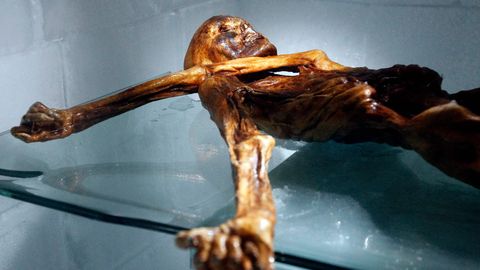
A new study revealed that the preserved remains of Ötzi the Iceman, who lived 5,300 years ago, still harbour an active microbial community. Scientists found both ancient and modern microorganisms. This discovery changes our understanding of mummy biology.
TehnoloogiaThe scientific world was astounded by a recent study showing that the remains of Ötzi the Iceman, discovered in the Alps, are anything but biologically inert material. In the 5,300-year-old remains, scientists have identified an actively functioning microbial community consisting of both ancient and modern microorganisms.
Surprising discovery
Ötzi, who was discovered in 1991 in the Alps on the border between Italy and Austria, is one of the world's best-preserved mummies. A new study shows that the microbes living in his body are still active thousands of years after death. This result was completely unexpected to scientists, as it was previously believed that remains so ancient are practically devoid of microbes.
What the study revealed
The study results suggest that Ötzi's microbial world is complex and multilayered — some microorganisms date back to his lifetime, while others entered his body over centuries or millennia. This discovery provides new information both about how mummies are preserved and about how microbes are able to survive in extreme conditions.
Significance for science
The finding is important from multiple perspectives. First, it helps us better understand how mummies should be preserved and studied to avoid contamination from modern microbes. Second, it opens new possibilities for studying ancient microorganisms, which may provide information about the history of human-microbe coexistence. Scientists believe that conducting similar studies could yield even more fascinating answers to the secrets of the ancient world.
Ava rakenduses →