Estonia's Puzzling Silence: Nuclear Capability Debate Suppressed by Security Concerns
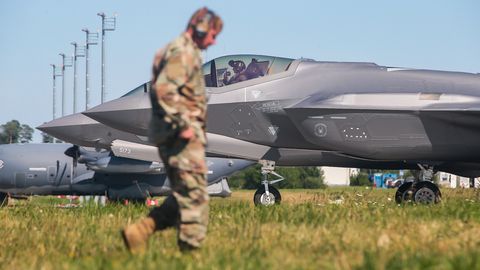
The Financial Times reported that the Baltic states and Poland are interested in hosting US nuclear-capable aircraft at their airbases. While Poland and Lithuania discuss nuclear capability publicly, in Estonia the debate falls silent as soon as nuclear-armed fighter jets are mentioned.
PoliitikaInternational media attention has turned to a peculiarity in Estonian public discourse: while other Baltic states and Poland discuss hosting US nuclear-capable aircraft relatively openly, in Estonia this topic appears to be largely taboo.
The contrast with neighbours is striking
In a recent article, the Financial Times highlighted that the Baltic states and Poland have sought to strengthen NATO's nuclear deterrent and are interested in US nuclear-capable aircraft being stationed at airbases on their territory. Poland has opened public debate on this issue at the highest political level, and Lithuanian officials are equally willing to engage openly. Estonia presents a different picture: as soon as someone mentions a fighter jet carrying nuclear weapons, people fall silent.
This pattern is particularly noteworthy given that Estonia is among the countries in the most vulnerable position towards Russia and has most consistently demanded the strengthening of NATO's eastern flank. Paradoxically, it is precisely here that public debate appears to be most restricted.
Security arguments become a barrier to debate
In Estonia, security arguments are often used to shut down discussion of this topic: it is said that public discussion of sensitive defence information may be dangerous. But critics point out that this justification does not explain why neighbouring countries can speak on the same subject without compromising security. Suppressing debate does not mean decisions are not being made – they are simply being made behind closed doors, out of public view.
In the broader NATO context, the nuclear capability question has become increasingly pressing. Russia's aggression in Ukraine and Moscow's nuclear rhetoric have prompted several allies to consider how to strengthen deterrence in eastern Europe. Several experts have emphasized that open democratic debate on such matters is part of a healthy security culture, not a weakness in it.
What does silence mean?
The question is not only whether Estonia should host nuclear-capable aircraft or not – this is a complex and controversial issue with compelling arguments on both sides. The question is whether such a decision should be made as a result of public debate or not. The experience of Estonia's neighbours shows that the topic can be addressed publicly without constituting a security risk. Informed public engagement in security debates may actually strengthen democratic legitimacy and society's resilience.
Ava rakenduses →